📩 123456829333565

Lithium Battery Recycling Plant
Plant Type: Lithium battery recycling plant
Feedstock: Spent lithium-ion batteries
Battery Types: NMC, LFP, EV batteries, cells, modules, packs
Main Product: Black mass, copper, aluminum, steel, plastics.
Capacity: 1500-1600kg/h (customized)
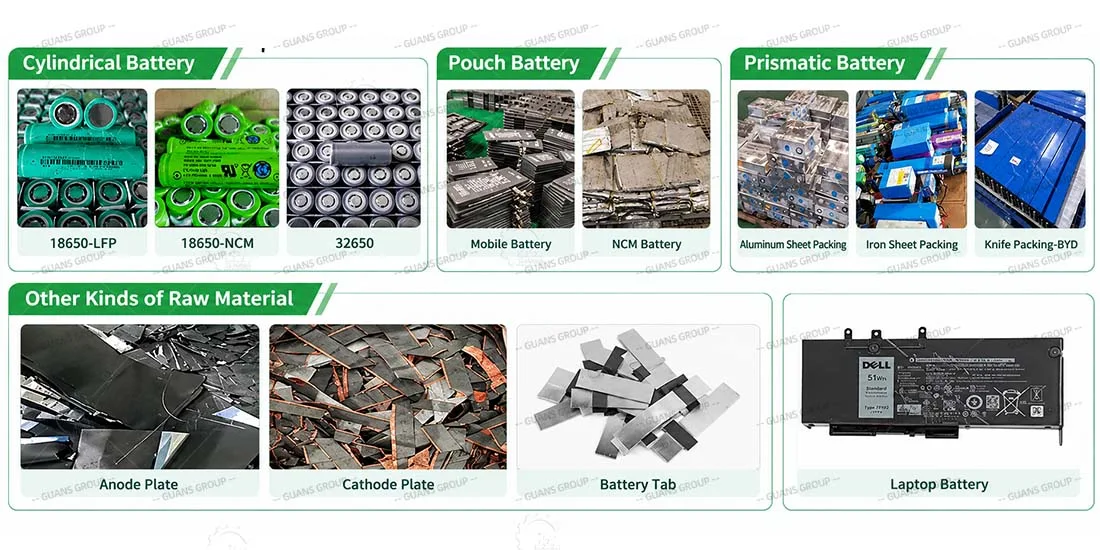
GUANS GROUP provides customized lithium battery recycling plants for processing spent lithium-ion batteries, including NMC, LFP and other lithium-based battery feedstocks.
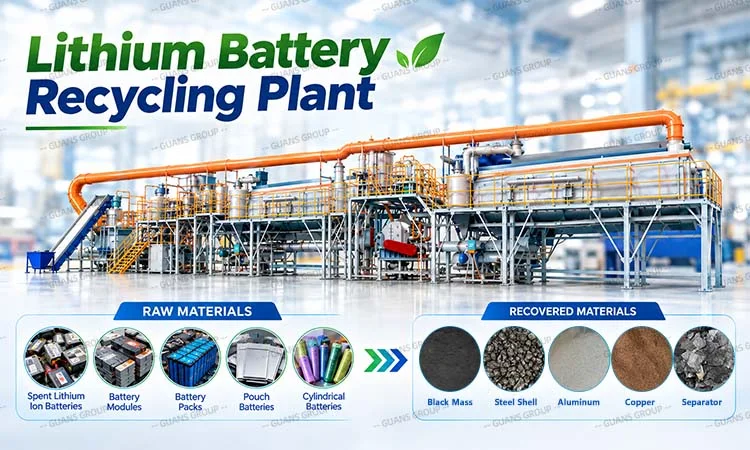
A lithium battery recycling plant is designed to safely process waste batteries and recover valuable materials through a combination of discharge, size reduction, mechanical separation, classification and material recovery technologies.
Lithium Battery Recycling Final Products
Depending on the battery chemistry and process configuration, recoverable materials may include black mass, copper, aluminum, steel, plastics and other material fractions.

Black Mass
Black mass can contain lithium and metals such as nickel, manganese, cobalt or lithium.

Copper
Separated copper foil and copper-rich material can be collected for downstream metal recycling.

Aluminum
Aluminum foil, casings and other suitable aluminum fractions can be recovered through mechanical separation.
Steel Shell
Steel components can be extracted using magnetic separation equipment.
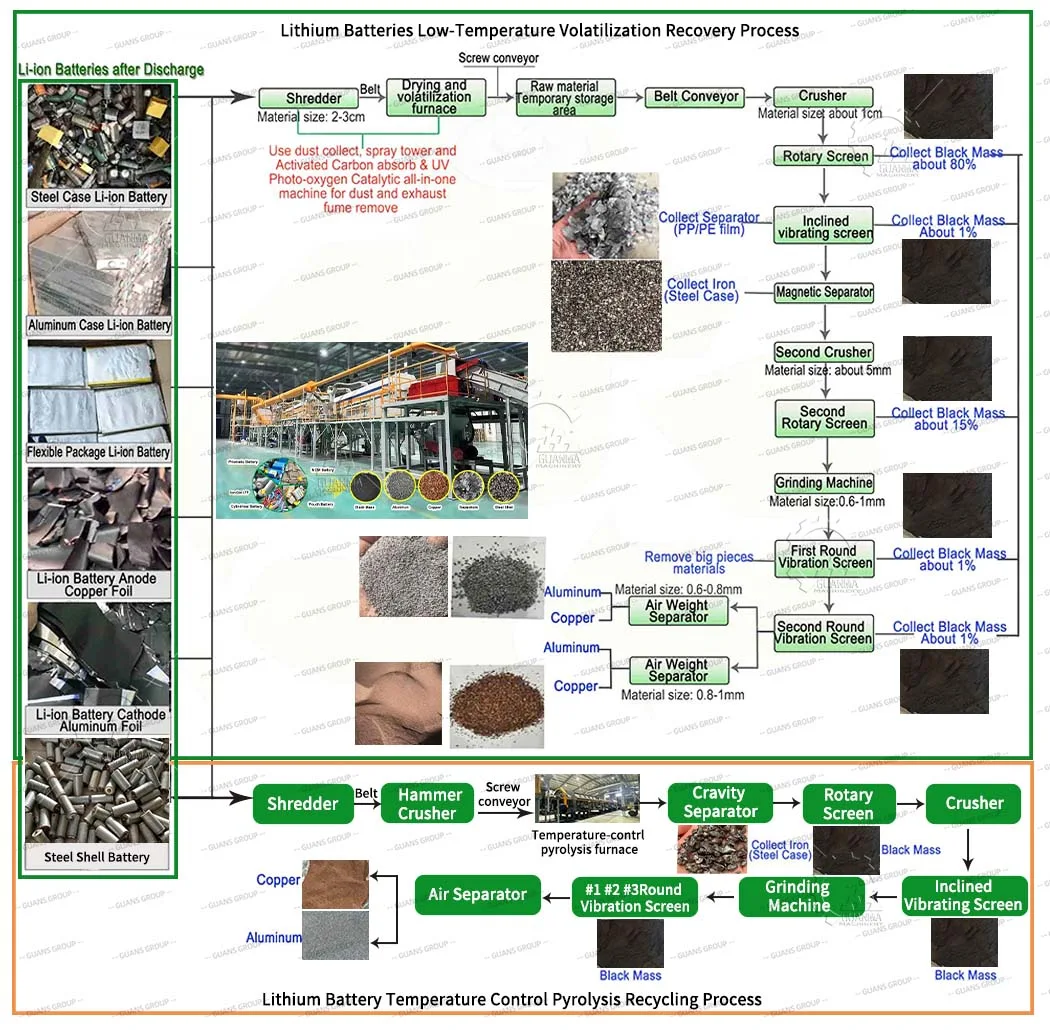
Lithium Battery Recycling Plant Processing Capacity
Lithium ion battery recycling machine can be customized according to customers’ requirements in terms of production capacity, voltage, and power.
| Model | PCS-500 | PCS-1000 | PCS-1500 |
|---|---|---|---|
| Capacity | 500*600kg/h | 800-1000kg/h | 1500-1600kg/h |
| Motor Power | 350 KW | 480 KW | 530 KW |
| Dimension (L×W×H) | 68*12*6m | 80*14*8m | 86*14*8m |
Note: Actual capacity, recovery performance, product purity depend on battery chemistry, feedstock composition and the selected process route.
Lithium Battery Recycling Process
The complete lithium battery recycling process depends on the battery chemistry and feedstock condition.
A typical lithium-ion battery recycling process comprises the following steps:
Spent Lithium Batteries → Battery Discharging → Dismantling → Shredding → Crushing → Screening → Magnetic Separation → Air / Density Separation → Fine Classification → Black Mass
The hydrometallurgical battery recycling process comprises the following steps:
Black Mass → Leaching / Chemical Treatment → Purification → Metal Recovery → Lithium / Nickel / Cobalt / Manganese Products
The exact process should be selected according to battery chemistry, feedstock composition, required products, plant capacity and local environmental regulations.
Core Lithium Battery Recycling Equipment
GUANS GROUP can configure a complete equipment line according to the customer’s battery type and processing requirements.
01 — Battery Discharging System
Reduces residual electrical energy before mechanical processing.
02 — Battery Dismantling System
Separates housings, connectors, cables and other components where required.
03 — Battery Shredder System
Reduces battery packs, modules or cells to a suitable size for further processing.
04 — Battery Crusher
Further liberates battery materials and prepares the feedstock for classification.
05 — Vibrating Screening System
Separates materials according to particle size and concentrates different fractions.
06 — Magnetic Separation System
Removes ferrous materials from the processed battery stream.
07 — Non-Ferrous Separation System
Separates suitable copper, aluminum and other non-ferrous fractions.
08 — Air Classification System
Uses controlled airflow to separate materials with different physical characteristics.
09 — Black Mass Recycling System
Collects the fine active-material fraction generated during the recycling process.
10 — Dust Collection System
Captures process dust from shredding, crushing, screening and powder separation stages.
11 — Powder Handling & Conveying System
Transfers recovered powder and separated materials between process units.
12 — Hydrometallurgical System
Optional equipment for customers who require additional recovery from black mass.
Actual capacity, recovery performance, product purity and equipment configuration depend on battery chemistry, feedstock composition, particle size, moisture, battery condition, operating conditions and the selected process route.
Why Choose GUANS GROUP?
GUANS GROUP combines equipment manufacturing, process engineering and turnkey project experience to develop lithium battery recycling solutions for international customers.
🏭 Direct Manufacturer
Get lithium battery recycling equipment directly from the manufacturer with engineering support throughout the project.
⚙️ Customized Recycling Process
We do not use one standard recycling process for every battery. The system is designed according to battery chemistry, feedstock characteristics and target products.
🌍 Global Installation Training
We provide overseas installation guidance, commissioning assistance, operator training.
🔬 Professional R&D Team
Dedicated research teams continuously improve recovery rates and maximize material separation efficiency.
♻️ Modular Plant Design
Start with mechanical recycling and expand to downstream refining when project requirements and investment plans allow.
📋 Complete Plant Solution
From battery pretreatment and shredding to black mass production and optional downstream recovery.
Start Your Lithium Battery Recycling Project
Turn spent lithium-ion batteries into valuable secondary resources with a recycling system engineered around your actual feedstock.
Frequently Asked Questions
What is a lithium battery recycling plant?
A lithium battery recycling plant is an integrated facility used to process spent lithium-ion batteries and recover valuable materials through discharging, dismantling, shredding, crushing, screening and separation processes.
What types of lithium batteries can be recycled?
Depending on the equipment configuration, the plant can be designed for suitable NMC, LFP, EV batteries, battery cells, modules, packs and battery manufacturing scrap.
Can NMC and LFP batteries be recycled in the same plant?
The basic mechanical process may share similar equipment, but the optimal process and downstream recovery route can differ because NMC and LFP have different material compositions. Feedstock evaluation is recommended before finalizing the plant configuration.
Can lithium battery recycling equipment process EV batteries?
Yes. The plant can be designed for suitable EV battery cells, modules and packs. Large battery packs may require additional dismantling and discharge stages before shredding.
Can the plant be customized?
Yes. Capacity, equipment configuration, automation level, plant layout, battery chemistry and downstream recovery processes can be customized according to the project.
What is the difference between mechanical recycling and hydrometallurgical recycling?
Mechanical recycling primarily uses physical processes such as shredding, crushing, screening and separation to produce material fractions such as black mass. Hydrometallurgical processing uses chemical treatment to further recover valuable elements from materials such as black mass.